Saturday, 25 April 2015

Estella (Character Analysis)


Portrayals of Estella played by a various number of actresses throughout the years.
(images courtesy of Google Images)

Estella has been played by a number of different actresses throughout the years since the publication of Charles Dickens' 'Great Expectations' in 1860. Her younger self at the beginning of the film is often played by a younger child actress and as she gets older towards the middle/end of the film her role is taken on by a more experienced actress. Different adaptations of the novel have resulted in her character being modernised in some of the portrayal, and obviously each actress has a different skill set so will focus and emphasise certain things about the character. However, despite this, there are a number of common factors that most, if not all, the actresses that have played Estella have channelled. 
Estella was raised by Miss Havisham, a lonely, bitter old woman who got rejected by her husband to be on the morning of their wedding. As a result of this she has trained Estella to hate the male species and lure them in, only to break their hearts. As a result of this the portrayals of Estella so far have shown her to come across as an extremely beautiful young lady who would be seen as attractive to any boy or man (depending on her age throughout the film) that comes across her. However the actresses that have portrayed her have done so as her having a beautiful outer layer but having a deceitful, spoilt and rude personality. In all her adaptations she is shown to be manipulating Pip into loving her so she can eventually break his heart. Her behaviour towards him is deemed as if she believes she is better than him, criticising his lack of money and appearance to her guardian in front of him where he must listen to her insults.

As a result of this consistent perception of Estella's character I would like to include these ideas as well as add some of my own thoughts into the mix. My first thoughts on how I will portray Estella are that I would like her to have pale flawless skin, this is due to the fact that I would like her outer appearance to be one that appears angelic and untouched by anyone or anything - no freckles as the sun hasn't damaged her skin, no cuts or bruises where she's been hurt, just a pale blank canvas, an eerily beautiful look. I would like both her hairstyle and her makeup to be simplistic enough to allow the idea of her 'natural beauty' shining through. To this I think the best colour scheme for her makeup to go along with her pale skin would be pinks, plumbs or light browns.
Her hair will be simply styled into ringlets, as to a head of ringlets is often used to represent sweet innocent young girls and was also a common element used in the styling of hair in the Victorian era.
I would expect Estella to walk as if she is gliding, staying at one level, even as her younger self is portrayed where she may usually bounce around like a young girl does, as this makes her appear angelic. Her head held up high, with her shoulders back when she is both walking and interacting with others (i.e. Pip) also helps to highlight her status and her belief she is better than those she is surrounded by. These small characteristics, although appearing to be simplistic are very effective in portraying her attitude and personality to the viewers despite its contrast with her appearance and will hopefully result in it making it difficult for the viewers to make their mind up on her - her appearing so young and angelic but acting so pompous and cruel, providing the viewers with a love-hate relationship for her character.

The Paradise (2012)


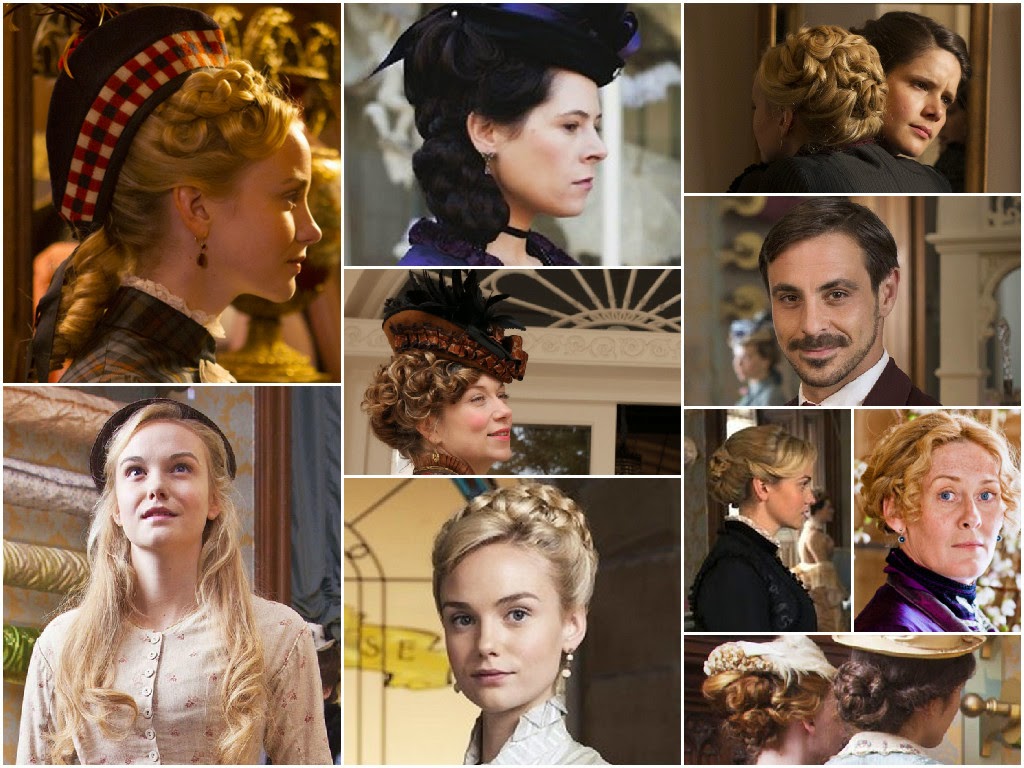
The paradise is a British television drama, written by Bill Gallagher, that launched its first series in 2012. The programme is based in 1875, during the mid-late Victorian era and portrays the lives of those working, trading and shopping in the first British department store. The series is focussed around the life of a young woman - Denise Lovett (played by Joanna Vanderham), and how she becomes engrossed in a society that is being modernised more and more everyday.

The series includes many woman, all varying in age which makes it ideal to show how, as the Victorian era progressed, the style of both clothing and hair was adapted and became more modern than its previous strict regimes.
In the early Victorian era (1830's - 1860's) hairstyling for woman of all ages was made up of three simple elements - middle partings, plaits and buns, however as time progressed the hair became more adventurous and, although these elements were still a big part of hairstyling for the Victorian women, the styles became less 'pristine' and more exciting.
For example, Young girls began to wear the beautifully long hair, they'd never cut, loose with a parting on the side, creating the appearance of a side fringe and allowing the younger generations to feel more free and actually act young rather than like mini versions of their parents. However, these were not the only changes. Women started to loose the perfectly drawn middle parting they had and began to have curls overlapping at the front of the hair, providing more volume and depth to their hair. They had perfect pin curls covering their whole head with out a plait or a bun in sight, don't get me wrong, the mid-late Victorian era still had plenty of plaits, but rather than being tight to the head and covering their ears they began to pile them into big buns on the top of their heads for a more sophisticated but youthful look. In the space of just 10 years the Victorian women's hair had gone from being tight with a not even a hair out of place to even the oldest generation of woman loosening up the curls and having it carelessly pinned back with a few even hanging out at the front or the back (sometimes both!).
I think the new looser hairstyles that came about in the later years of the Victorian period and therefore those that are seen in 'The Paradise' episodes are a result of the growing independence women were gaining throughout the years. It was becoming more and more normal for women to get jobs (just as Denise Lovett did in the series), only a few years before it would have been unheard of for a young girl of her age to be working like she was. The looser hair shows the looser strain of rules the Victorian society once faced. 

I really enjoyed watching this series as, after seeing films etc. based in the early Victorian era it was refreshing to watch something that was in the same era but yet had so many differences after just a few years. The way the woman's behaviour and  hairstyles change was intriguing to me. I found that I do prefer the hairstyles I saw represented in 'The Paradise' simply because, although they used many of the same techniques they had in the early years of the Victorian era, they did lots of different things with them and rather than all the females of similar age groups having the exact same hairstyles, the characters in this series all have different hairstyles throughout the film that change, overall I felt it just made them more interesting and easier to differentiate between.

Jane Eyre (2011)


The story of Jane Eyre was a heart-wrenching tale originally published by Charlotte Bronte in 1847. It tells the story of a young girl who flees home to become the governess of Thornfield house, only to be faced by the cold and abrupt master of the house - Mr. Rochester. Throughout the novel the pair become closer and Jane breaks through her masters icy exterior, however his troublesome past comes back to haunt them.

The novel is set in the earlier Victorian era and the 2011 adaptation directed by Cary Fukunaga depicts the early Victorian hairstyles perfectly.


The first image is of  actress Mia Wasikowska in her role as Jane Eyre. Her character is a young woman in the early Victorian era and her hair throughout the film is representative of this. He hair is perfectly parted down the middle with the front of her hair brought round to the back, covering her ears and then plaited into a low bun at the nape of her neck - all elements described in my post about early victorian hairstyles. Her role as a governess meant that she had to look after and educate her masters children, therefore her hair had to be in a practical style that prevented it from getting in the way when she was working. This style helps to represent her as sophisticated and respectable as well as being efficient for her job.


 The second image is of Tazmin Merchant playing the role of Mary Rivers, Jane's cousin and also working as a governess. She is seen as a role model for Jane - young, independent and confident. Her hair throughout the film is, like Jane, a portrayal of how young women wore their hair in the early victorian era - away from the face, neat, professional but also representative of her class and age. The hair is parted in the middle then plaited and then wrapped into two buns either side of her head.


The third image is a completely different take on the woman of the early Victorian era. This is the character of Mrs. Reed, played by Sally Hawkins, who is Jane's 'evil' Aunt. She always despised Jane bringing her up as she felt her husband showed more love for Jane than their own children. Her appearance throughout the film is an obvious representative of both her wealth as well as her age. The character wears her hair up in extravagant styles with various accessories to go with her extravagant outfits. This was common in older Victorian women as they attended many dinners and court dances where they would all compete to be the best and most beautiful. The use of the middle parting, plaits and buns as well as having her ears covered were all common in early Victorian hairstyling.


I included this image of Jane Eyre and Mrs. Fairfax (Judi Dench), the housekeeper of Thornfield House, as it is representative of how different head wear represented different parts of the life of a Victorian woman in the early era.  Mrs. Fairfax's lace headpiece was commonly worn by married women to cover the back of their hair. It could be worn out under a bonnet and often the upper class wore various colours to match their outfits. Jane's bonnet with a frilled edge was often worn out to keep the hair in place when out and about. The detail of the bonnets differed between classes but often Mistresses would pass down old bonnets to their workers to help them appear more presentable when representing their family.


The last two images are of male characters from the 2011 film adaptation of 'Jane Eyre'. The first is of Mr. Rochester himself  (played by Michael Fassbender). His character is that of a wealthy, middle aged Victorian man. The second image is of  actor Jamie Bell who plays the role of St. John Rivers, another of Jane's cousins but also her benefactor, providing her with food and shelter. John acts as the Minister of Morton making him too, reasonably wealthy. Both men are well dressed throughout the film and sport the same hair that most men across all social classes in the early Victorian era had, short back and sides with the hair on top combed over and oiled. The men also often had long sideburns that merged into facial hair that went around the jaw of the mans face. The males hair throughout the early Victorian era is no where near as complex as the women's, it remained very simplistic but evidently effective in attracting women and wealth.


I like the hairstyles seen throughout this remake of Jane Eyre as they are a precise and realistic representative of those that would have been found in the early Victorian era. I feel that the film makes you feel like your in the era when watching it as they carry off the style and looks so effectively.


http://www.bl.uk/romantics-and-victorians/articles/the-figure-of-the-governess
http://www.katetattersall.com/early-victorian-womens-hats-part-1-concerning-bonnets/
http://www.imdb.com/media/rm417839616/tt1229822?ref_=ttmi_mi_all_sf_2

Victorian Hair for Children

http://www.ehow.com/info_8085877_childrens-victorian-hairstyles.html
http://victoriantruth.blogspot.co.uk/2008/07/from-commonly-held-misconceptions-about.html


Although much of the work we have done on hair for our course focuses on women's hairstyles throughout the Victorian era, I was intrigued to see how the Victorians styled their children's hair .. were the young girls hairstyles as extravagant as their mothers? So I decided to carry out some independent research and heres what I came across ...
The 'French Coiffure'
Despite the adult roles being 'extremely gender specific', up until around the age of four or five both girls and boys were dressed alike - wearing long, loose dresses and hair either curled or waved. However after they left nursery the children were treated and dressed like miniature adults, the boys hair was cut short at the back and sides and parted on top then oiled into place, whereas little girls remained long and was curled into ringlets or 'sugar curls' by tying hair up in rags the night before.

The 'Chignon'
The boys hair always remained pretty much the same throughout their lives, however as the girls became older their hair became more elaborate and detailed, used as a representative of their coming of age. The hair would still be curled but often 'tied up in a looser version of their mothers hair', however at 16 they would begin to wear their hair in a 'Chignon' (a low bun at the nape of the neck) or a 'French Coiffure' to make them more presentable for courting.
As the Victorian Era progressed, the regulations for children became more lax, and the girls were able to wear their hair in styles similar to those we still see today - loose and flowing, ponytails, plaits etc. 


The various hairstyles over the Victorian era for young girls.


Friday, 24 April 2015

Early Victorian Hairstyles

The way women styled their hair in the early Victorian era (1830's - 1850's) was mainly dependent on their social class. This is because those deemed low/working class citizens needed practical hairstyles that would allow them to complete the jobs they were required to do, such as be a maid/servant, without their hair getting in the way. Therefore as a result of this the majority of working class women had their hair tied back into plaits and buns most of the time while they were working. In the evenings the women may have styled their hair in order to seem appealing to their husbands such as having their hair in ringlets but unlike those wealthier than them they could afford the resources to create more extravagant looking styles.
In addition to the fact that wealthier women were able to afford better resources to help with styling their hair such as bonnets, flowers and other hair accessories to make the styles more appealing, these women also had more extravagant hairstyles due to their social lives. Wealthier citizens often attended large dinner parties, balls etc. Therefore they had more opportunity to dress up and experiment with various hairstyles.

Image taken from http://www.fashion-era.com/hair_hats_184070.htm

However, regardless of the difference in class, there were a number of elements that were common across all Victorian women's hairstyling. First of all it was extremely popular for women to have a parting directly down the centre of their head throughout the early Victorian era as it made the hair look neater and perfected. 

image taken from
http://individual.utoronto.ca/beaujot/web2/bib.html
In addition to this, despite the differences in the ways the hair was styled across different social classes, the factors that went in to creating the hairstyles were mainly based around plaits, buns and ringlets. The majority, if not all victorian hairstyles used either one or all of these elements. Various plaits were used to create different styles (fishtail plaits, standard plaits, french plaits etc.) sometimes the hair was plaited into a bun at the back of the head or hair was plaited along the sides of the head and into a bun at the back, curls were styled in various ways, sometimes the whole head was curled and then styled or other times women created a number of identical ringlets at the sides of their head - but the same ideas were used in styles across the classes. 

When it came to evening wear, upper class women often had the hair in curls piled up on the top of the head with maybe a few curls hanging out at the back down the neck, as well as including various colourful flowers, lace, ribbon etc to make the hair more exciting and encouraging them to be in competition with other women attending the event to be the most beautiful and extravagant out of them all.

image taken from
https://www.pinterest.com


Ageing Hair

Health & Safety:
Place an apron round the models neck to ensure their clothing is protected from any stains or damage.
Make sure you wash your hands thoroughly with soap before touching the models skin or hair.
Ensure you conduct a client consultation to check for any allergies, infections or contraindications.

Equipment Used:
- Dry Shampoo
- Supracolour Palette (Black and White)
- Disposable Mascara Wands (x2)

Step by Step:
1. If you wish to turn the whole head of hair grey then you are best off using a dry shampoo. This is easily done by spraying the areas of the hair you wish to turn grey with the dry shampoo and then slightly rubbing it through so the product doesn't just sit on the head . You can keep repeating this process until the level of grey you want is achieved.

2. However if you are looking to turn a small amount of hair grey, for example; eyelashes, eyebrows, small strands of hair or facial hair then you are better of using the black and white in the supracolour palette. Mix together the black and white supracolour (the amount of each colour you use depends on what shade of grey you wish to achieve - the more black the darker the shade of grey/the more white the lighter the shade of grey will be). Take a disposable mascara wand and run it through the mixed supracolour. Begin combing the supracolour through the hair you wish to make grey until the area is covered. Then take the clean disposable wand and comb the area. This will prevent the grey supracolour looking like its sitting on the hair and will instead make the grey hair look more realistic.

Evaluation:
I found the process of ageing hair quite straightforward and easy enough to accomplish, therefore it was not a struggle to achieve. However after experimenting on different hair types I have found that dry shampoo can struggle to both appear grey on some hair types as well as sticking to some hair types. However I think the way around this would just simply be to have to keep repeating the process when necessary.


The Portrayals of Miss Havisham

Florence Reed  (1934)

http://i.telegraph.co.uk/multimedia/archive/02063/Florence-Reed3_2063022i.jpg
Florence Reed was an American actress from Philadelphia known for her roles in films such as The Black Panther's Club (1921), Her Own Way (1915) and Her Game (1919). Reed was one of the first actress to take on the role of Miss Havisham from Charles Dickens novel Great Expectations channeling the drawn haggard lady at the age of  51. The detail in the makeup, making the character look withdrawn and older than her time was very effective in making the character more believable. In addition to this pinning the hair up out of the face in a bun structure helps reinforce the ageing of the character, making her appear older and frailer, the combination of these two components helped make Reed's portrayal of Miss Havisham a success. 


Martita Hunt (1946)

http://i.dailymail.co.uk/i/pix/2010/07/01/article-1291188-00D174FE00000190-710_233x423.jpg
Martita Hunt was a British actress (although originally from Argentina) who was famous for her diverse range of roles as Queens, shrews and evil characters. The actress reprised her role as Miss Havisham in 1946, under the direction of David Lean, after her earlier portrayal in the 1939 stage adaption by Alec Guinness. 
The actress' 1946 portrayal was less focused on ageing and making the character look withered and withdrawn but instead was more focussed on how being jilted at the aisle had defined her as a woman, the veil and wedding dress she never took off making her appear almost as a fairy godmother, guiding and protecting Estelle.


Margaret Leighton (1974)

http://i.telegraph.co.uk/multimedia/archive/02062/Margaret-Leighton_2062993i.jpg
Margaret Leighton was a British theatre actress who made her debut at the tender age of 16 as Dorothy in TV movie Laugh With Me (1938). She took on her role as Miss Havisham at the age of 52, just a year before she passed away. The actress channeled the crazy character by sporting an eerily pale skin tone (an obvious side effect of the character not leaving the house for over 15 years) and wearing the wedding dress the character never managed to take off after being deserted by her future husband. Both these factors combined with the light hair and dark eyes made Leighton's portrayal ghost like, a very effective interpretation as it seems since Miss Havisham was rejected, she has never been able to regain her character, staying indoors slowly loosing her mind, her personality a ghost of the woman she once was.

Joan Hickson  (1981)

http://www.telegraph.co.uk/culture/culturepicturegalleries/8907506/Gillian-Anderson-Helena-Bonham-Carter-and-Miss-Havisham-on-film.html?image=15
Joan Hickson began her long and successful career on stage, performing in the theatre throughout World War II. The actress then gradually began to receive screen roles in works such as The Outsider (1948) and The Promoter (1952), eventually leading her to her role in the TV series adaptation of Charles Dickens 'Great Expectations' as Miss Havisham. The actress played the role at the age of 75, making her portrayal of the character more focused on how after being inside for so many years, mourning over the marriage she never got to have, she was haggard, withdrawn and frail. Her skin dry and colourless, sinking and sagging due to her distress. Another completely different but successful portrayal of Miss Havisham.


Jean Simmons (1989)

http://www.telegraph.co.uk/culture/culturepicturegalleries/8907506/Gillian-Anderson-Helena-Bonham-Carter-and-Miss-Havisham-on-film.html?image=16
Jean Simmons portrayal of Miss Havisham in 1989 came after her debut at 15 years old as Margaret Lockwood's sister in Give us the Moon  (1944). After many different roles, the actress portrayed Dickens' character at the age of 60. Her portrayal focused on the richer aspects of Miss Havisham's character, from her posture to the props such as the small umbrella she held. The natural ageing of the actresses skin helped to emphasise the struggle the character has been through and how she has suffered due to the lack of light and her distress at being rejected by the man she was supposed to marry.


Anne Bancroft (1998)

http://www.gothic.stir.ac.uk/wp-content/uploads/2011/11/bancroft.jpg
This adaptation of Dickens' Great Expectations'  is most probably one of the most eccentric to date. Not only because they have modernised the world surrounding the characters but also the characters themselves. This is clearly evident in Anne Bancroft's role within the film. Directed by Alfonso Cuaron, the role of Miss Havisham is adapted to a character named Ms Dinsmoor, a character that doesn't appear to bare much similarity to any of the previous portrayals of Havisham. This version ignores the usual customs such as her still wearing her wedding dress or the wedding cake in the corner covered in cobwebs but instead has created and produced something brightly dressed and loud. However Bancroft's character is still manipulative, bitter and venomous just as Miss Havisham has always been, only the extreme eye makeup and bright clothing provides a new, refreshing take on the novel which in turn provides a new outlook on the character altogether.


Charlotte Rampling (1999)

http://www.listal.com/list/evolution-charlotte-rampling
Charlotte Rampling is an English actress born in 1946, who still has an amazingly successful career today at the age of 69. In 1999, at the age of 53, the actress landed the role of Miss Havisham in a TV movie adaptation of Charles Dickens' Great Expectations, directed by Julian Jarrold. Her portrayal of Miss Havisham was monarch like and in some ways sophisticated. The wealth of the character is obvious in her wedding dress and her appearance, this portrayal is more dignified than some of the previous representations of Miss Havisham, her distress of being rejected by her fiancee is less visually evident in her appearance than it has been i other portrayals.


Gillian Anderson (2011)

http://i.telegraph.co.uk/multimedia/archive/02063/Gilian-Anderson5_2063010i.jpg
Gillian Anderson is a successful actress of todays film and TV industry, starting out in 1986 at the age of 18, starring in Three at Once as 'Woman 1', she then carried on to eventually land a leading role in The Fall recently in 2014. During this period she took on the role of Miss Havisham in a TV series of Charles Dickens Great Expectations produced by Rebecca Eaton. Her portrayal of the character channels a woman who has spent so much of her time inside, contemplating her losses in life that it has led her to become lost and insane. Her character moves between manic, lost and manipulative, but Anderson's portrayal is convincing and effective in all states. 
On top of this, Anderson's makeup and costume for the role is also very effective, her snow-white skin and dark eyes show how she has been a recluse in doors for so many years. Her off-white wedding dress represents her troubled past and the dead bouquet she carries around is effective in showing viewers how she hasn't let her go her past rejection.

Helena Bonham Carter (2012)

http://i.telegraph.co.uk/multimedia/archive/02374/helenaHaversham_2374575b.jpg

Helena Bonham Carter is renowned for her extreme and adventurous roles within the film industry, from her character as Bellatrix Lestrange in the Harry Potter films to Mrs Lovett in Sweeney Todd. Her ability to channel a character is astonishing, in an interview she explained how when she was assigned the role of Miss Havisham in the 2012 reproduction of Great Expectations she did research on what the physical side effects of staying indoors for over 15 years would do to a body and the state of mind and then channelled this into her character. The pale skin helped to reinforce this idea and the veil over her face made her appear widow like, mourning her non-existent marriage.